Subterranean termite treatment in Fayetteville addresses active colonies of Reticulitermes flavipes nesting in the sandy loam soils across Cumberland County. Homes in historic Haymount and wooded Vanstory Hills…
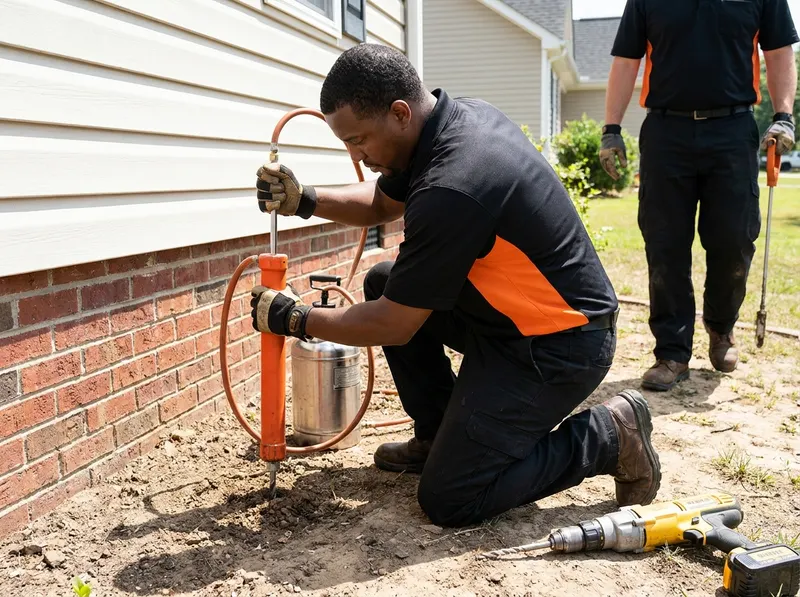
Subterranean termite treatment in Fayetteville addresses active colonies of Reticulitermes flavipes nesting in the sandy loam soils across Cumberland County. Homes in historic Haymount and wooded Vanstory Hills frequently feature ventilated crawlspaces or perimeter footers that bring untreated framing into proximity with damp earth. When spring swarms emerge along the Cape Fear River corridor, worker termites enter structural sills through foundation hairline cracks as narrow as 1/32 of an inch. A complete liquid perimeter barrier creates a non-repellent transfer zone: foraging workers pass through the active agent without avoidance, grooming nestmates and transferring the termiticide to the queen beneath the frost line.
Selecting between full liquid perimeter trenching and exterior bait station arrays depends on structural construction and surrounding landscape. Liquid barrier treatments fit slab-on-grade houses in Montclair and Ponderosa, where specialized rods inject termiticide beneath attached carports, front porches, and perimeter slabs to halt underground entry paths immediately. Bait stations fit properties along water-adjacent parcels near Arran Lakes West and Kings Grant, where high water tables preclude continuous perimeter soil saturations; stations establish active monitoring monitors spaced every 10 to 15 linear feet around the foundation perimeter. Liquid treatments establish an immediate defensive zone that persists for 5 to 10 years, whereas bait monitors require systematic bi-annual or annual cartridge inspections. Localized spot treatments starting at $250 resolve isolated structural infestations, though spot applications leave adjoining perimeter walls unshielded against secondary soil tubes.
Treatment execution follows three operational steps: 1. Technicians inspect the perimeter, floor joists, and crawlspace footings, mapping moisture levels and mud tubes. 2. Crews dig a continuous 6-inch by 6-inch trench directly against exterior foundation walls, rodding liquid termiticide at a standard rate of 4 gallons per 10 linear feet. 3. Slabs abutting the foundation are drilled at 12-inch intervals, treated via hydraulic injection, and patched with concrete. For homeowners near the Jack Britt district or military personnel moving to and from Fort Liberty, service operates with zero ongoing maintenance contracts. Structural clear reports document all treated zones. Scheduling requires direct confirmation at (910) 412-0283.
Every job gets a firm, written price after a free on-site visit.
Tell us about your subterranean termite treatment job in Fayetteville and we'll send a clear, written quote, usually the same day.
 Praxeno Pest Solutions