Powderpost beetles (predominantly Lyctinae and Anobiidae family species) target unfinished hardwood and softwood framing timbers, converting internal cellulose into a powdery frass that weakens the structural integrity…
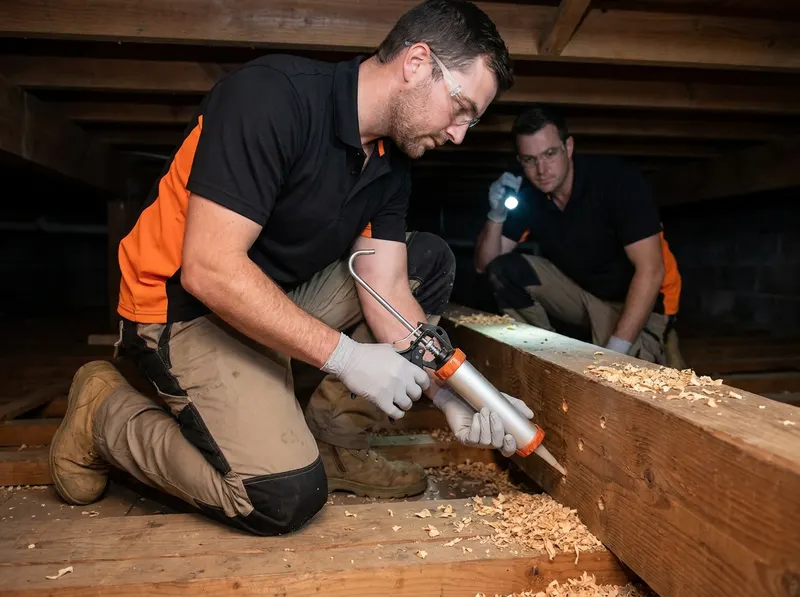
Powderpost beetles (predominantly Lyctinae and Anobiidae family species) target unfinished hardwood and softwood framing timbers, converting internal cellulose into a powdery frass that weakens the structural integrity of residential floors. In historic Haymount crawlspaces and established Vanstory Hills foundations, crawlspace subfloors consistently capture high ambient humidity rolling off the Cape Fear River basin. If timber moisture registers at or above 14% to 18%, structural framing creates an ideal incubation environment for wood-boring larvae. Remediation differs substantially from surface insect spraying: topical contact sprays do not penetrate interior wood fibers where larvae feed for one to four years. Remediating structural framing requires deep-penetrating borate salt solutions applied directly to bare wood, which crystalizes inside the timber fibers to neutralize larvae as they ingest treated cellulose.
Homeowners selecting remediation must distinguish between true active beetle activity and dormant historical emergence holes. An active infestation manifests through fresh, cream-colored wood powder (frass) piling beneath pinhole-sized exit points (1/16 to 1/8 inch diameter) along crawlspace joists, subflooring, or sill plates. If the frass is caked or dark brown, the infestation is often historical and requires no chemical intervention. For active infestations, topical pesticide fogging offers zero lasting value; liquid penetrants formulated with disodium octaborate tetrahydrate deliver long-term residual protection because the minerals remain bound to the timber indefinitely. Trade-offs exist: if timber has previously been sealed, painted, or encapsulated with polyurethane, penetrative borate cannot absorb directly into the wood grain. In those scenarios, structural components either require surface mechanical sanding to expose raw lumber or targeted pressurized injection directly into active gallery channels.
Environmental moisture management determines long-term success across wet clay-heavy zones near Arran Lakes West, Jack Britt, and Montclair. Elevated ground moisture keeps sill plates damp, providing continuous hydration for re-infestation. Remediation sequences pair targeted chemical applications with 6-mil to 10-mil polyethylene ground vapor barriers to reduce crawlspace timber moisture levels below the critical 12% threshold where larvae cannot develop. Property owners are never pressured into mandatory multi-year quarterly maintenance contracts; structural wood-boring treatments function as a closed, decisive corrective protocol that solves the primary biological threat at its source.
Every job gets a firm, written price after a free on-site visit.
Tell us about your powderpost beetle & structural wood boring remediation job in Fayetteville and we'll send a clear, written quote, usually the same day.
 Praxeno Pest Solutions