Crawlspace environments in Cumberland County face persistent rodent pressure due to the sandy loam topsoil and high humidity common to the Sandhills region. Properties in older communities like Haymount and Vanstory…
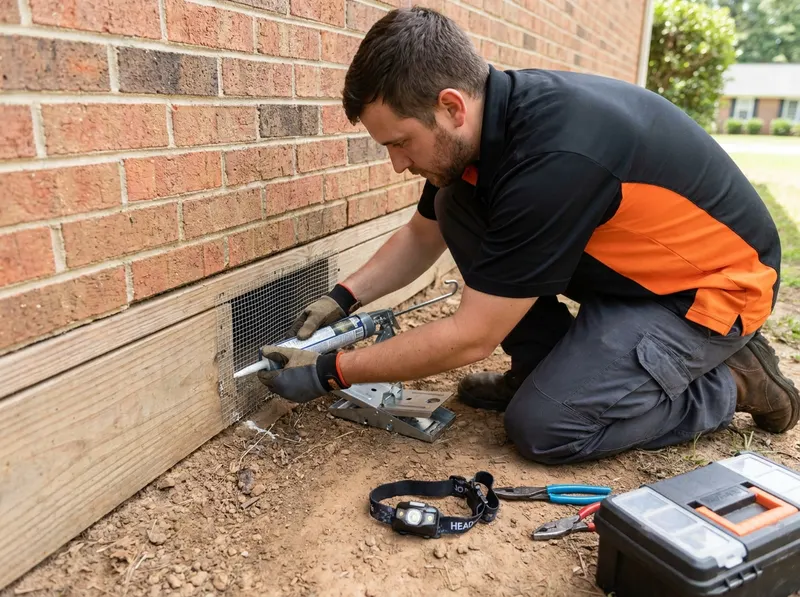
Crawlspace environments in Cumberland County face persistent rodent pressure due to the sandy loam topsoil and high humidity common to the Sandhills region. Properties in older communities like Haymount and Vanstory Hills often feature vented brick foundations where foundation settling creates openings exceeding one-quarter of an inch. Roof rats exploit overhanging oak branches to access soffits, while Norway rats burrow directly beneath foundation footers adjacent to air conditioning condenser pads. Installing quarter-inch 19-gauge galvanized hardware cloth over crawlspace vents stops incoming vectors permanently, whereas standard insect screens rip under rodent gnawing forces.
Subfloor plumbing lines beneath kitchens and bathrooms represent the primary bridge between crawlspaces and living quarters in neighborhoods such as Jack Britt, Montclair, and Arran Lakes West. Trapping inside the crawlspace requires non-toxic mechanical snap traps deployed along active perimeter joists and main sill plates. Rodent bait stations containing second-generation anticoagulants carry a distinct risk of rodents expiring inside enclosed interior drywall cavities, generating severe odor and secondary fly infestations. Mechanical crawlspace trapping captures the pests within the subfloor footprint, allowing direct carcass removal within 48 to 72 hours without toxic residues circulating near household pets or crawlspace ductwork.
Properties bordering dense pine canopies near Carvers Creek State Park or damp drainage corridors near the Cape Fear River require physical barrier defenses rather than ongoing chemical dispersion. A full mechanical exclusion plan addresses pipe penetrations, rim joists, crawlspace access hatch doors, and perimeter foundation vents. While temporary foam sprays degrade under UV exposure and rodent teeth within 3 to 6 months, steel flashing backed by copper mesh provides an impenetrable boundary. Crawlspace vapor barriers torn by rodent nesting behavior are evaluated during inspection, establishing clear structural containment boundaries prior to trap retrieval.
Every job gets a firm, written price after a free on-site visit.
Tell us about your rodent exclusion & crawlspace trapping job in Fayetteville and we'll send a clear, written quote, usually the same day.
 Praxeno Pest Solutions