Stinging insect pressure accelerates rapidly across the Sandhills region between late May and October. In neighborhoods such as Haymount, Vanstory Hills, and Buckhead, mature oak canopies and historic residential…
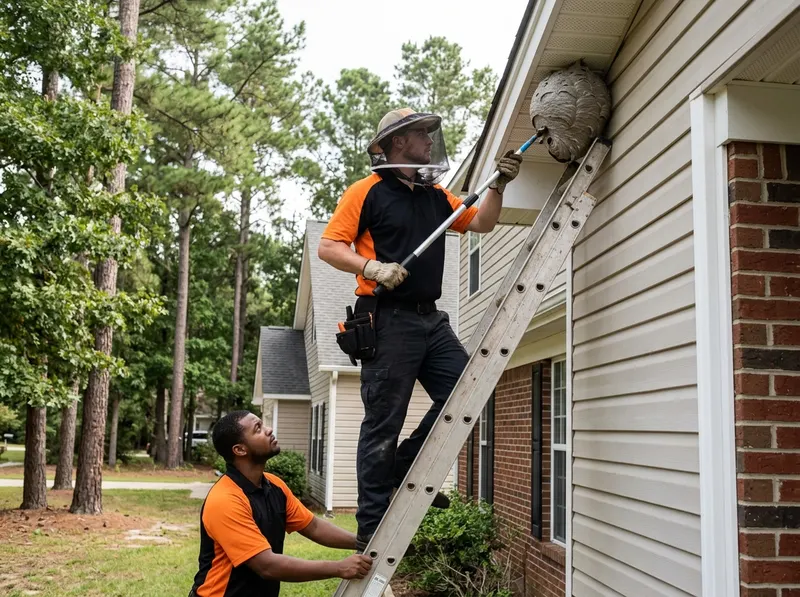
Stinging insect pressure accelerates rapidly across the Sandhills region between late May and October. In neighborhoods such as Haymount, Vanstory Hills, and Buckhead, mature oak canopies and historic residential rooflines provide sheltered soffits where bald-faced hornets construct expansive carton nests. European hornets frequently hollow out porch ceilings or void spaces along fascia boards, while eastern yellowjackets colonize underground rodent burrows in the sandy soils of Montclair, Ponderosa, and Arran Lakes West. A single mature hornet colony contains between 400 and 1,000 active defensive workers, which release volatile alarm pheromones upon detecting exterior vibration or physical approach. Attempting to spray these colonies with retail foaming aerosol cans from ladders frequently triggers mass swarming events without reaching the interior brood comb.
Professional elimination resolves the issue through direct application rather than temporary displacement. Treatments utilize specialized extension injection poles loaded with targeted synthetic pyrethroid dust or non-repellent transfer compounds applied straight into the nest entrance. This method arrests the primary queen and circulating sentinels within 15 to 30 minutes, preventing defensive dispersal into nearby living spaces. Structural wall voids near Terry Sanford, Kings Grant, and Jack Britt residences require precision void-dusting rather than exterior sealing; sealing an active hornet entrance before neutralizing the colony forces workers to chew inward through interior sheetrock, introducing dozens of aggressive insects into living rooms or bedrooms.
Selecting a standalone nest extraction fits situations where an immediate physical threat compromises doorways, play areas, or military family housing near Fort Liberty. It avoids the recurring fee structure of generic quarterly spraying programs while directly solving an urgent structural hazard. The operational trade-off of a targeted single-event removal is the lack of broad, yard-wide seasonal barriers. Homeowners choose between paying a focused fee to neutralize a dangerous, active nest immediately or committing to continuous exterior barrier maintenance. Physical nest extraction occurs only after insect activity ceases, followed by scraping the anchor point clean and treating the substrate with an enzymatic residual spray to prevent subsequent queens from rebuilding on the identical footprint.
Every job gets a firm, written price after a free on-site visit.
Tell us about your stinging insect & hornet hive removal job in Fayetteville and we'll send a clear, written quote, usually the same day.
 Praxeno Pest Solutions